|
Cattery Located in Southern California in the San Diego area.
To inquire about a sphynx shown on the kitten adoption page
contact me at:
brooke.wallhauser@gmail.com
(619) 980-9232
| Father of available kittens |
|
|
| OhNaturalBrooks Streaker - chocolate and white bicolor with extremely deep blue eyes |
| Champion sphynx in my breeding program |
|
|
| Ch. Sundabcebear flame dancr and Ch Haddakat Orchid |
|
|
| Male kitten solid black available now |
| contact me regarding the available of kittens |
|
|
| Kittens available to be released early summer 07 |
| This kitten is currently available to an approved |
|
|
| AuNatural bebe biggles bw - Mink calico |
|
|
| female breeder |
Kittens are bred for type, temperment and health. Show quality kittens available from CFA champion parents. Regional winning
quadruple grand champion lines. Also kittens from a Russian imported queen. Kittens are available now to be held by reservations
until they of age to be released.
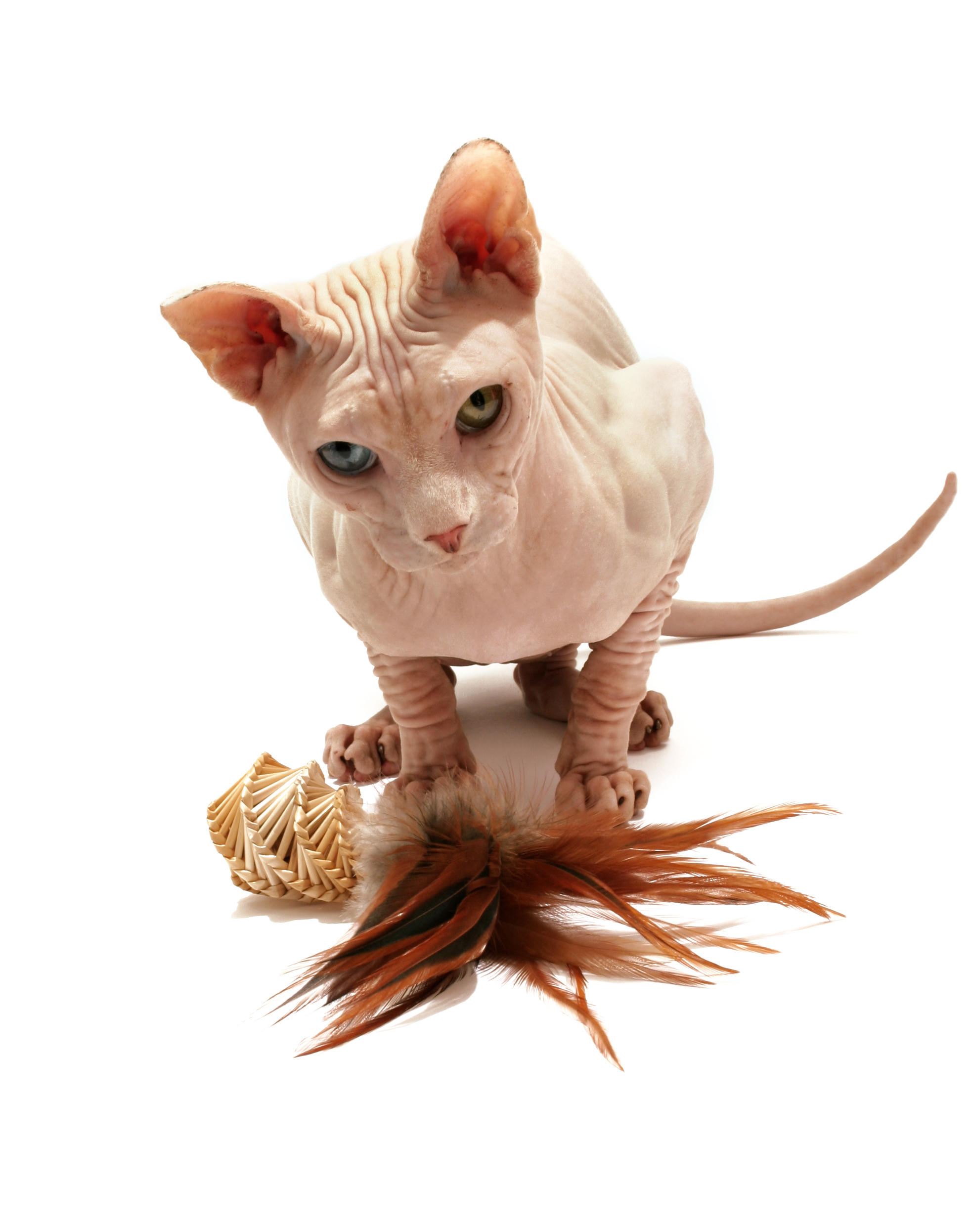
Sphynx look like Aliens, or Grimlins with there huge ears, extreme wrinkles, and curly Q tail they also have long figer
like paws with raised pads making them appear to be walking on a cloud.
Sphynx kittens are available now. The kittens and cats bred for health, type and temperment. They are never caged and
the parents are test for FELV and FIV and are neg.
Sphynx kittens become reserved quickly so it is important to put a deposit on a kitten early or submit your name and email
to my wait list to be notified when kittens are available.
Personality: It has been said by those who find the Sphynxunusual looking, that what the cat lacks in looks, it makes
up in personality! If you want an intelligent lap cat, get a Sphynx! These cats are very outgoing and demand attention. They
seem to follow you everywhere. They Purr extremely loudly which can offen times be heard from across a room. Their affectionate
nature is addictive and most people who own them can not stop at owning just one. To say that the Sphynx is one of the most
unusual breeds of cats is an understatement. In fact, when one first looks at a Sphynx, the word cat does not come to mind.
With its big ears, all knowing expressions, and wrinkled face, the word alien seems more appropriate. The Sphynx is one of
the rarest cats in the world. The reason for the rarity of this species is that it is only recently that a concerted effort
has been made to preserve the Sphynx breed. So few people had ever seen the Sphynx. They are extremely friendly and loving.
These pets are for those people who want their pets to be with them, as Sphynx physically like to be on their owners. The
European standard for this breed goes so far as to describe them as, " part dog, part child, part monkey, and part cat."
Sphynx owners all over the world reported their cats as highly intellegent, loving, and almost human in their behavior. Most
Sphynx are bold & outgoing, active and family oriented. They have never meet a stranger they dont like and will steal
the hearts of your guests. They are definitely "people cats". They will sleep with you if you let them. They are
very vocal Many of them can learn to play fetch. The Sphynx cat loves children and other animals.
Contact me at 619-584-2527 or 619-980-9232
to reserve at kitten
scroll down for more pictures
Breed Profile: Sphynx
In 1966 a domestic cat gave birth to a hairless kitten in Toronto, Canada. It was discovered to be a natural mutation
and the Sphynx cat, as we know it today, came into existence. This cat and a few other naturally hairless cats have been found
worldwide. These have magically been produced by Mother Nature and are the foundation for this unusual breed. Cat breeders
in Europe and North America have bred the Sphynx to normal coated cats and then back to hairless for more than thirty years.
The purpose of these selective breedings was to create a genetically sound cat with a large gene pool and hybrid vigor. This
is a very robust breed with few health or genetic problems.
The Sphynx is not always totally hairless; there can be a fine down on the body, which makes the cat feel like a warm
peach. Some light hair is often present on the nose, tail and toes. The texture of the Sphynx skin has been likened to suede,
a hot water bottle, or a heated chamois. They can be registered in a wide variety of cat colors. The color is seen in the
pigment of the skin and the few hairs that they do have. One of the questions most asked is "Don't they get cold?"
Well, of course, if it is too cold for you it will be too cold for a hairless cat too. However, these cats are smart enough
to find a warm human, dog or cat to curl up with or they will get under your bed covers.
This is a substantial cat, medium sized and strong, with adult males being larger than adult females. Sphynx have sturdy
boning and good muscle development and should have a bit of a belly as if they just finished dinner. They have an open-eyed,
intelligent face and a friendly expression. The Sphynx are extremely inquisitive and love to be the center of attention. They
perform silly antics for your entertainment and are sometimes downright clumsy…on purpose it seems. They make great
show cats because of this "look at me" attitude and they are easy for judges to handle. They prefer human attention
but enjoy the company of dogs and other cats. They have an abundance of energy and mischief and are always with you, on you
or showing off for you. "Love Mooch" is the perfect term for these amazing cats.
Because of the lack of hair that would normally absorb body oils, the Sphynx needs to be bathed periodically. This is
not a difficult task with a cat that has been accustomed to a bath from kittenhood and it takes no time at all to dry a Sphynx.
Some people who suffer from cat allergies can tolerate living with Sphynx cats. However, depending on the type and severity
of the individual's allergic reactions, there are still people who cannot live with this breed.
The Sphynx was accepted for registration, and competition, in the Miscellaneous Class by The Cat Fanciers' Association
(CFA) in February 1998. Sphynx lovers feel this is one of the most rare and unusual breeds in the cat fancy today…Sphynx
are pure enchantment.
Sphynx are rare and most breeders have a waiting list for their kittens. Pricing on Sphynx usually depends on type, applicable
markings and bloodlines distinguished by Grand Champion (GC), National, National Breed and/or Regional winning parentage (NW,
BW, RW) or of Distinguished Merit parentage (DM). The DM title is achieved by the dam (mother) having produced five CFA grand
champion/premier (alter) or DM offspring, or sire (father) having produced fifteen CFA grand champion/premier or DM offspring.
Usually breeders make kittens available between twelve and sixteen weeks of age. After twelve weeks, kittens have had their
basic inoculations and developed the physical and social stability needed for a new environment, showing, or being transported
by air. Keeping such a rare treasure indoors, neutering or spaying and providing acceptable surfaces (e.g. scratching posts)
for the natural behavior of scratching (CFA disapproves of declawing or tendonectomy surgery) are essential elements for maintaining
a healthy, long and joyful life.
MORE ON SPHYHX HISTORY
Hairless cats have been documented for many years, dating back to at least 1902, when a Mr. and Mrs. Shinick of Albuquerque,
NM were given a pair of hairless cats (Nellie and Dick) by the local Pueblo Indians. They were brother and sister, and pictures
of them described them as completely hairless with wedge-shaped heads, big ears, long bodies and long whip-like tails. From
the descriptions the cats sounded as though they were probably bicolors. They were further described as having very short
fur on their backs and along their tails in the winter that would fall off in warmer weather. Their eyes were "amber"
and they had long whiskers. The cats were never bred, and Dick was killed by a dog at a young age.
In the 1930's hairless cats were reported in such diverse places as France, Morocco, and the United States. Dr. E. Letard,
a veterinarian, documented hairless kittens born to Siamese parents in France.
There has been quite a bit of information available about the "birth" of the "modern Sphynx", beginning
in 1966. On 30 January, 1966, a black and white domestic shorthair queen gave birth to a litter of kittens, one of which was
a black hairless male. Mrs. Yania Bawa and her son Ridyadh Bawa acquired this kitten, whom they named "Prune", as
well as Elizabeth, his mother. They named their cattery after Prune, and he became "Prune of Prune". The Bawas bred
Prune back to Elizabeth and on 16 January, 1967 she gave birth to seven kittens, among them two hairless females and two hairless
males. Kees and Rita Tenhove also began working with the Bawas, with the cattery name of Dutchie's. Houston E. Smith of Bor-Al
Cattery later joined the Bawa's. None of the breedings between Prune & Elizabeth resulted in kittens who were able to
successfully reproduce further offspring. Because of this and other reasons, CFA decided at that to time to not allow the
Sphynx in to Championship status.
The now defunct Crown Cat Fanciers Association recognized the Sphynx for Championship competition in 1971, and GRC Dutchie's
Nefertiti of Mewsi-Kal, bred by the Tenhoves and owned by Sandy Kaiser, became Crown's first and only Grand Champion Sphynx
in 1973. Two offspring of Nerfertiti, Mewsi-Kal Starsky (a male) and Mewsi-Kal Johnny (a female... at first she had been thought
to be a male, hence the uni-sex name!) went to The Netherlands in 1978 to help Dr. Hugo Hernandez with a beginning breeding
program. Starsky was not terribly interested in breeding his sister. She did manage to get pregnant once, but the entire litter,
delivered via c-section, died.
Between 1978 and 1980 three hairless kittens were found on the streets of Toronto by local children. They were brought
to Shirley Smith, a Siamese breeder. Mrs. Smith kept Bambi, the male (born in June of 1978; more on him below) and sent the
two females, named Paloma (born in September of 1979) and Punkie (born in April of 1980) to Dr. Hernandez in The Netherlands.
Starsky was not too interested in Punkie and Paloma either. He also began to spray, and since he was acting like a stud
cat in every way except for breeding Dr. Hernandez decided to have him neutered. Punkie did end up pregnant, after Starsky
was neutered, but the entire litter died.
Now without a male Sphynx, Dr. Hernandez sent Paloma to live with Hanna Nathans. He decided to try using a Devon Rex to
breed to Punkie and Paloma, and a white male named Curare van Jetrophin successfully bred Punkie. The Sphynx was on its way
in Europe. Two males from this breeding, Q. Ramses and especially Q Ra (out of Punkie) are quite prominent in many, if not
most Sphynx pedigrees today.
From Hanna Nathans (de Calecat) and Tonia Vink (Ajahanda's) the Sphynx eventually found its way to France. Patrick Challain
and Guy Patigny were the owners of Chnoem de Calecat, known in the United States as "ET". This cat came to the US
in 1986 to do PR for the INCATS show at Madison Square Garden. Unfortunately he died in a fire back in France the next year.
Aline and Philippe Noel acquired Ajahanda's Atilla Timothy and Ajahanda's Zendila from Tonia Vink, and these two cats have
played a very important role in the history of the Sphynx in the United States.
In 1978 Punkie and Paloma's older brother Bambi was born. His story was told in the May, 1985 issue of Cats Magazine.
He was found on the streets of Toronto, and by the time Shirley Smith got a hold of him he was in pretty bad shape. His left
eye had been punctured in three places and his genitalia was so badly mutilated that everything had to be removed. In 1986
Shirley Smith's health was declining, so she placed Bambi, named for his big doe eyes, with a close friend. In 1990 Bambi's
new owner had to find him another home and he ended up with Linda Birks of Aztec Cattery. Bambi was the oldest Sphynx on record,
and he passed away in June of 1997, at the age of nineteen. Bambi never produced any kittens of his own, but he helped greatly
to propel the Sphynx into the public eye with the Cats Magazine article.
So it appears from all of the written accounts, as well as pedigree information, that the "original" Sphynx
from Canada, specifically the Bawas' and Tenhoves' cats, have no bearing on the Sphynx of today. In fact, it was recently
written by Bruce Fogle, D.V.M., "The first Sphynx, Prune, was born in 1966, but his line died out." Yes, the other
Sphynx from Canada, Punkie and Paloma, are an important part of the breed today, but read on and I think that you will agree
with me that the Sphynx is a "North American" breed, not exclusively a Canadian breed.
There have been breeders working with the Sphynx in the United States since the mid 1970's. In 1975 a domestic shorthair
cat was abandoned on the farm owned by Milt and Ethelyn Pearson in Wadena, MN. They named the brown tabby female "Jezabelle".
Shortly after her arrival on the farm Jezabelle gave birth to a hairless kitten. The Pearsons named the little female "Epidermis".
A year later Jezabelle gave birth again, to another hairless female, whom the Pearsons named "Dermis". When Mrs.
Pearson's job obligations got to the point where she felt she could no longer give the cats the attention they needed, she
reluctantly sold them in 1981 to Kim Mueske of Z. Stardust Cattery. Kim's first attempts at breeding the cats occurred shortly
thereafter, to a blue-eyed white American Shorthair, CFA GRC Sailaway Willie. Epi and Dermi produced seven kittens between
them, all normal-coated. Three years passed before Kim tried again, this time to an American Shorthair named Red. Epi produced
two normal-coated male kittens, and upon the advice of Dr. Solveig Pflueger she bred one of the males, Z. Stardust Sneezy,
back to his mother and was rewarded with three hairless kittens. In 1986 Kim planned to have Epi spayed, but Epi had other
ideas. Cantaur's Hercules of Z. Stardust, a Devon Rex who was also scheduled to be neutered, and Epi had one last fling and
in the resulting litter was born the foundation queen, SGC Z. Stardust's Winnie Rinkle of Rinkurl, OD, TICA's first Outstanding
Dam Sphynx and a cat who figures quite prominently in many of today's Sphynx pedigrees. Thank goodness for feline persistence
(and sneakiness)! Winnie passed away in March of 2002 at the ripe old age of 16, after a long battle with breast cancer.
Also in Minnesota, down the road from Wadena in Brainerd, Mrs. Georgiana Gattenby was working with hairless cats. Her
cattery Jen Jude was named for a daughter and St. Jude. Her three foundation cats, Jen Jude King Tutt , Jen Jude Sheba, and
Jen Jude Cleopatra, were acquired from Mrs. Pearson in the fall of 1978. Patricia Jacobberger, a CFA judge and Ellen Ainsworth,
an American Shorthair breeder both visited Mrs. Gattenby's cattery in 1980 and took many photos of the cats. On 28 April,
1979 King Tutt and Sheba presented Mrs. Gattenby with her first hairless kitten, Jen Jude Different. Mrs. Gattenby used a
few Cornish Rex, referred to in her cattery records as simply "Rex" (Devons were not accepted as a different breed
at that time) as an outcross. One of them, Silk Screen Ripples, was bred to Different three different times. Two of their
hybrid kittens produced both hairless and coated kittens when bred back to a Sphynx. Mrs. Gattenby sold her last two remaining
cats, Jen Jude Yoda II and Jen Jude Girlie, to Brenda S. Pena in 1985 and 1986. Mrs. Gattenby was not in good health sadly,
and died shortly thereafter. After repeated attempts, Yoda and Girlie produced a litter of kittens in 1988. Two of them, CH
Brenda's Bathsheba of Rinkurl and particularly QGC/RW Brenda's Nefertiti of Rinkurl, OD, can also be found in many Sphynx
pedigrees today.
Even when Mrs. Gattenby was working with the Sphynx there was quite a bit of interest in the breed. She had many letters
from interested people, and advertised in Cat Fancy in 1985.
THE SHOW SCENE
While there were people working with the Sphynx prior to TICA's acceptance of the breed for Championship competition in
1986, the breeders who put the Sphynx on the map again were Walt and Carol Richards of Britanya Cattery. In 1986 their Devon
Rex female Britanya's Aida Lott produced a litter of four kittens, sired by Chnoem de Cal CA in July of 1986, where they created
quite the sensation. Lady Godiva went on to become TICA's first Supreme Grand Champion Sphynx and TICA's first International
Best of Breed Sphynx, and Lord E became TICA's first Outstanding Sire Sphynx. Britanya cats figure quite prominently in many
pedigrees of today's Sphynx, and the Richards' can certainly be accredited with a good part of the fabulous success of the
breed both in and out of the show ring.
As the Sphynx gained popularity through its exposure in TICA, other cat associations have followed suit in recognizing
them for Championship status. In 1992, thanks to the efforts of Linda Birks (Aztec Cattery) the Sphynx was recognized for
Championship competition in the Canadian Cat Association (CCA). Two years later, in 1994 the American Cat Fanciers' Association
(ACFA) accepted the Sphynx into the Championship ranks. The American Cat Association (ACA) recognized the breed in 1995. The
smaller cat associations such as AACE and UFO included the Sphynx as a Championship breed since their inceptions. And finally,
at their Semi-Annual Board Meeting in February of 1998, CFA accepted the Sphynx as a Miscellaneous breed, after a long, long
absence. At the semi-annual board meeting in Austin Texas, in February of 2002, the Sphynx were promoted directly to Championship
status.
Pet, Breeder and Show Kittens are available. Kittens can be held by deposit. However if an available kitten is ready to go
the the full payment is expected. After you have made the deposit you can choose from the available sphynx kittens. The adoption
process includes submit your info. Depending on age of kitten if it is ready to go send full payment Airline cost are additional
the fee is $200 for the shipping, crate, and health certificate. You may make a deposit which is $300 and is non refundable
if you decide not to get a kitten. Kittens are sold with a sale contract and health guarntee which gives you a chance to have
or veternarian check out the kittens health. Breeder kittens are of highest quality. All Sphynx here are raised for apperance,
temperament, and health.
Sphynx Kittens and young adults are available: Pet adults or kittens will be spayed / neutered. A deposit is necessary
to recieve a sphynx kitten or to hold a kitten for you the deposit becomes credit and will go towards purchase of a Sphynx
prices are as follows Pal pal is only available for deposits to hold a kitten. Your kitten will be sent to you as soon as
the kitten reaches the age requirements of the airline to ship. You can also pick up your sphynx instead and visit my home
which I encourage everyone to do. If you would like to make a deposit pay pal is available towards the bottom of the page.
Or contact me for my address to send a caishers check or money order. If the kitten is picked up cash is prefered.
CFA SPHYNX STANDARD
GENERAL: the most distinctive feature of this cat is its appearance of hairlessness. The Sphynx is of medium size and
body conformation with surprising weight for its size. Females are generally smaller than males. The head shape is a modified
wedge, with prominent cheekbones and whisker pads giving a squared appearance to the muzzle. The body feels warm and soft
to the touch, with a skin texture akin to either a soft peach or a smooth nectarine. The Sphynx is sweet-tempered, lively,
and amenable to handling.
HEAD: the head is slightly longer than it is wide, with prominent cheekbones and a distinctive whisker break. The skull
is slightly rounded with a flat plane in front of the ears. The nose is straight and there is a slight to moderate palpable
stop at the bridge of the nose.
CHEEKS AND CHEEKBONES: prominent, rounded cheekbones which define the eye and form a curve above the whisker break.
MUZZLE AND CHIN: whisker break with prominent whisker pads. Strong, well developed chin forming perpendicular line with
upper lip.
EARS: large to very large. Broad at the base, open and upright. When viewed from the front, the outer base of the ear
should begin at the level of the eye, neither low set nor on top of the head. The interior of the ears is naturally without
furnishing
EYES: large, lemon-shaped, with wide-open center while coming to a definite point on each side. Placement should be at
a slight upward angle, aligning with the outer base of the ear. Eyes to be wide set apart with the distance between the eyes
being a minimum of one eye width. Eye color immaterial.
BODY: the body is medium length, hard and muscular with broad rounded chest and full round abdomen. The rump is well rounded
and muscular. Back line rises just behind the shoulder blades to accommodate longer back legs when standing. Boning is medium.
NECK: the neck is medium in length, rounded, well muscled, with a slight arch. Allowance to be made for heavy musculature
in adult males.
LEGS AND FEET: legs are medium in proportion to the body. They are sturdy and well muscled with rear legs being slightly
longer than the front. Paws are oval with well-knuckled toes; five in front and four behind. The paw pads are thick, giving
the appearance of walking on cushions.
TAIL: slender, flexible, and long while maintaining proportion to body length. Whip-like, tapering to a fine point.
COAT/SKIN: the appearance of this cat is one of hairlessness. However, short, fine hair may be present on the feet, outer
edges of the ears, the tail, and the scrotum. The bridge of the nose should be normally coated. The remainder of the body
can range from completely hairless to a covering of soft peach-like fuzz, no longer than 1/8th of an inch (two millimeters)
in length. This coat/skin texture creates a feeling of resistance when stroking the cat. Wrinkled skin is desirable, particularly
around the muzzle, between the ears, and around the shoulders. There are usually no whiskers but if whiskers are present they
are short and sparse.
COLOR: color and pattern are difficult to distinguish and should not affect the judging of the cat. White lockets, buttons,
or belly spots are allowed
Apperance:
Once you get used to looking at a naked cat, you will notice that this breed has other distinctive traits. Their
ears, for one thing, look large enough to intercept satellite transmissions. Their paw pads are thick, giving them the
illusion of walking on tiny air cushions. The large, lemon shaped eyes are expressive, slightly
slanted, and set wide apart. The head is a modified wedge shape, with prominent cheekbones and whisker pads and a strong,
well-developed chin. Medium-sized cats, Sphynx are broad-chested and hard-muscled. The Sphynx skin is very wrinkled the cats
skin is the thinnest of all the domestic animals, and also the most flexible. It's easier to see the wrinkles on a hairless
cat. Sphynx feel like warm suede to the touch. Despitethe virtual lack of hair, Sphynx come in every possible color and
pattern. However, the exact color is sometimes difficult to determine on a hairless cat, so in the show ring no points are
awarded or taken away for color or pattern. Like the gene for long hair, the gene that governs the Sphynx lack of hair is
recessive. In order for a cat to be hairless, it must inherit one copy of the Sphynx gene from each parent. If a cat has
one copy of the hairless gene and one copy of the gene for short hair, the cat will have short hair but will carry the gene
for
hairlessness. When two such cats are bredsome of the kittens will be hairless. On the plus side, when two hairless cats
mate they produce entirely hairless litters.
If you have an questions about the kittens don't hesiate to contact me.
Kitten application form please send me an email and include the following info.
Your Name
Your e-mail
Is there a specific kitten/cat you are interested in?
If so, please tell me.
What made you decide on the sphynx?
What interests you about the breed?
Have you ever owned a cat? What breed? How long?
Please tell us about them.
Do you have any children? If so, how many? What are their ages?
Do you live in a house, apartment, or condo? Do you rent?
If you rent, may we eventually contact your landlord
to establish that they have granted permission for a pet?
Do you have any pets at present? Please tell us about them
Please list the name and phone number of the Veterinarian
you are currently using, or plan to use for your new pet.
The SPHYNX, above all else, is a hairless cat. The hairlessness of the SPHYNX, of course, results from differences in hair
deposition and/or maintenance between the SPHYNX and normally coated breeds. We will discuss empiric, scientific and statistical
data as it relates to the physiologic, biochemical and genetic differences that separate the SPHYNX from other normally coated
breeds and that allow for variances within the SPHYNX for degree of hairlessness. Sanspelo suggests that you review the discussion
on normal feline hair growth before reviewing the discussion of hairlessness.
The history of hairless cats--note that "hairless" is a relative term in this discussion as most hairless cats
do have at least a fine stubble of hair--is a repetitious cycle of the spontaneous, sporadic appearance of one or two hairless
cats in a litter with other normal coated siblings. As we move through the twentieth century, we see that those naturally
occurring mutations are reported approximately once a year somewhere in the world--usually in the northern latitudes of North
America or Europe. In our development of the SPHYNX breed, we have worked with a particular gene for hairlessness (hr) which
we describe in Mendelian genetic terms as recessive to the gene for normal coat (Hr) and incompletely dominant to the gene
for the Devon Rex coat (re). However, in observing our SPHYNX through their life cycles, we note that some SPHYNX known to
be heterozygous with the Devon gene (hr re) remain very hairless throughout all conditions of their entire lives, some relatively
hairy throughout all conditions of their lives and some vary depending on their environmental and hormonal conditions. Likewise,
SPHYNX known to be homozygous (hr hr) also fall into a similar spectrum. Further, we know that this gene site (hr, Hr, re)
can determine hair stability (SPHYNX ) and/or curliness (Devon Rex) and that hairs that do grow carry the pigment of their
coat color at the site of deposition--this categorizes them as either primary or secondary guard hairs and suggests the lack
of Down hairs in the SPHYNX . Lastly, we have observed that the SPHYNX phenotype is associated with a decreased anagen:telogen
ratio, early breakage of the cat's whiskers and early loss of teeth, which are similar to hair in that they are also of ectodermal
origin thus giving them a commom developmental pathway.
What Does a Sphynx Feel Like?
The Sphynx is a cat that feels like a suede hot water bottle. The lack of hair, and therefore the lack of cooling air
space under the hair, makes the cat feel much hotter to the touch than any other cat. This comes in handy in the winter time
when they crawl under the covers to go to sleep.
What Should a Sphynx Look Like?
The ears of a Sphynx are very large. They are set neither too high nor too low in the head. The eyes are lemon shaped.
The profile has a gentle curve. There should be a long chin and a definite pinch at the whisker break.
The cat should stand like a bulldog with the elbows slightly turned out, and a broad chest enhances this appearance. The
body should be pear shaped. A sphynx should not be fat but should look as though it has just eaten a big meal, which it most
often has, since these cats are voracious eaters. They eat and drink more than other cats to maintain their higher body metabolism,
which helps them deal with temperature control. Sphynx have extra long toes, and since they do not have fur to restrict them,
they can make little fists with their front paws. The cats also have thick paw pads which give the impression that the cat
is walking on air cushions. A long whippy tail completes the look of the Sphynx cat.
| Cream mink aqua eye female sphynx kitten available |
|
|
| Tortie female and black male available now |
|
|
Sphynx look like Aliens, or Grimlins with there huge ears, extreme wrinkles, and curly Q tail they also have long figer
like paws with raised pads making them appear to be walking on a cloud.
Sphynx kittens are available now. The kittens and cats bred for health, type and temperment. They are never caged and
the parents are test for FELV and FIV and are neg.
My breeding program offers excellent show lines with CFA and TICA kittens available from a CFA Champion stud and Regional
winning and grand champion lines. Also I have breeders in my program imported from Russia. Occassionaly Blue and Aqua eyed
are kittens available.
Sphynx kittens become reserved quickly so it is important to put a deposit on a kitten early or submit your name and
email to my wait list to be notified when kittens are available.
Personality: It has been said by those who find the Sphynx unusual looking, that what the cat lacks in looks, it makes
up in personality! If you want an intelligent lap cat, get a Sphynx! These cats are very outgoing and demand attention. They
seem to follow you everywhere. They Purr extremely loudly which can offen times be heard from across a room. Their affectionate
nature is addictive and most people who own them can not stop at owning just one. To say that the Sphynx is one of the most
unusual breeds of cats is an understatement. In fact, when one first looks at a Sphynx, the word cat does not come to mind.
With its big ears, all knowing expressions, and wrinkled face, the word alien seems more appropriate. The Sphynx is one of
the rarest cats in the world. The reason for the rarity of this species is that it is only recently that a concerted effort
has been made to preserve the Sphynx breed. So few people had ever seen the Sphynx. They are extremely friendly and loving.
These pets are for those people who want their pets to be with them, as Sphynx physically like to be on their owners. The
European standard for this breed goes so far as to describe them as, " part dog, part child, part monkey, and part cat."
Sphynx owners all over the world reported their cats as highly intellegent, loving, and almost human in their behavior. Most
Sphynx are bold & outgoing, active and family oriented. They have never meet a stranger they dont like and will steal
the hearts of your guests. They are definitely "people cats". They will sleep with you if you let them. They are
very vocal Many of them can learn to play fetch. The Sphynx cat loves children and other animals.
scroll down for more pictures
|